Sign In / Create Account
Apartment Pet Policy Breed Restrictions: 2026 Rules
Apartment pet policy breed restrictions are lease rules that ban specific dog breeds, driven mainly by the property's liability insurance.

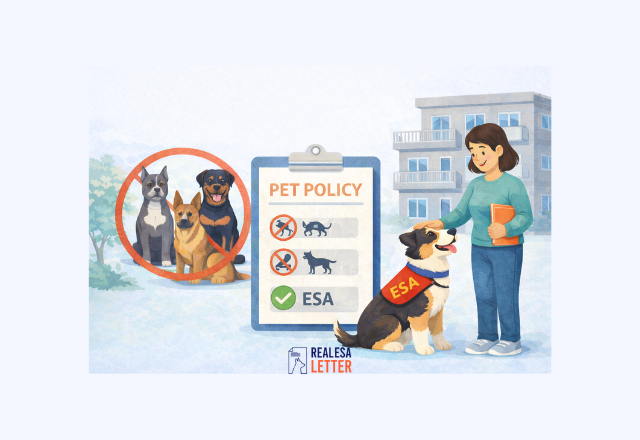
Key Takeaways:
Breed restrictions are lease policy, not law: Landlords ban certain breeds because their liability insurance excludes them, not because a law requires it.
Restrictions follow looks, not DNA: Mixed breeds get flagged if they visually resemble a restricted breed, even without genetic proof.
The ESA rule changed on May 22, 2026: HUD rescinded its 2013 and 2020 notices, so an ESA letter no longer automatically overrides breed restrictions.
Requests are now assessed individually: Documentation quality and the dog's own record decide the outcome of a breed-restriction accommodation request.
Concealing a restricted breed backfires: Hiding your dog's breed is a lease violation that risks eviction and denied insurance claims.
Understanding Apartment Breed Restrictions
If your dog is on a building's restricted list, it’s the lease, not the law, that is usually what's stopping you. Breed restrictions usually sit alongside weight limits and pet fees; in HOA communities, they may live in the association's rules instead.
Two things every renter should know:
- Most restrictions are lease policy, not law. Only a few cities ban breeds by law, known as breed-specific legislation (BSL), Miami-Dade County's pit bull ban is one example. The American Veterinary Medical Association notes many of these local bans are being repealed. A lease policy can be negotiated; a city ordinance cannot.
- Read the pet addendum before applying.Check three things: the restricted breeds list, the weight limit, and the rules for assistance animals. Renters with an assistance animal should confirm they hold a legit ESA letter before approaching a restricted property.
Why Do Landlords Enforce Breed Restrictions?
Landlords often enforce breed restrictions to comply with insurance requirements, reduce liability for dog-related incidents, and protect their property from damage.
Insurance requirements are the primary driver. Property insurers maintain internal lists of breeds they consider high risk. When a restricted breed is present, insurers may refuse to renew coverage, exclude animal-related incidents, or significantly raise premiums. For most landlords, that cost outweighs accommodating a particular breed.
Local ordinances add another layer. Certain cities and counties have enacted breed-specific legislation that landlords are legally required to follow, regardless of their personal position on the policy.
Size and energy levels also factor in. Some restrictions target large or high-energy breeds because of their physical impact on a unit. Flooring, walls, and fixtures in smaller multi-unit buildings are more vulnerable to damage from powerful animals, and landlords price that risk into their policies.
Which Dog Breeds Are Most Commonly Restricted in Apartments?
Restriction lists vary by building and insurer, but the some breeds appear consistently restricted:
- Pit Bulls and Staffordshire Terriers
- Rottweilers
- German Shepherds
- Doberman Pinschers
- Chow Chows
- Huskies and Alaskan Malamutes
- Great Danes
- Mastiffs and Cane Corsos
- Wolf hybrids
Most of these breeds are flagged based on historical insurance data rather than the behavior of any individual animal. This is precisely why ESA protections exist as a legal override for tenants who need these animals for their mental health.
Do Breed Restrictions Apply to Emotional Support Animals in 2026?
Since May 22, 2026, breed restrictions can apply to emotional support animals: an ESA letter no longer automatically overrides an apartment's breed policy. The answer to this question changed in 2026, here is the clear explanation.
The old rule (2013–2025) | The current rule (since May 22, 2026) | |
Governing guidance | HUD FHEO Notices 2013-01 and 2020-01 | HUD memorandum rescinding both notices |
Breed restrictions vs. ESAs | ESAs were categorically exempt from breed restrictions as a reasonable accommodation under the Fair Housing Act | No categorical exemption; requests are evaluated under an individualized, ADA-style assessment |
What a landlord could do | Could not deny an ESA based on breed alone | May weigh breed policy, insurance requirements, and the individual animal's record |
What documentation did | An ESA letter effectively settled the question | Documentation quality is one factor the landlord evaluates |
Under the old guidance, the answer was "yes, an ESA letter overrides breed restrictions" and from 2013 through 2025, that was correct.On May 22, 2026, HUD rescinded FHEO Notices 2013-01 and 2020-01, ending the categorical exemption.
Requests are now assessed individually: a documented disability-related need still carries real weight, but a landlord may now consider breed as part of the evaluation. The full shift is covered in our guide to HUD's 2026 ESA policy changes.
Practically, documentation quality and the animal's individual record now matter more, not less.
RealESALetter.com letters include the clinician's state license number and direct contact information, which landlords now weigh when evaluating breed-restriction accommodation requests under HUD's individualized assessment standard.
What Additional Pet Restrictions Do Apartments Commonly Enforce?
Breed is not the only factor landlords regulate. Most pet policies include additional conditions that apply to pets.
Weight limits. Many buildings set a maximum weight threshold, commonly between 25 and 50 pounds, barring larger dogs entirely.
Age restrictions. Puppies under one year are frequently prohibited due to damage risk before the animal is fully trained.
Pet count limits. Most buildings cap animals per unit at two. Requests beyond that are typically denied without individual review.
Exotic animal bans. Reptiles, large birds, spiders, and animals classified as exotic under local law are universally prohibited due to liability and insurance concerns.
Landlords routinely charge pet rent for standard pets. These charges do not apply to documented ESAs or service animals under the Fair Housing Act.
How to Get Around Breed Restrictions When Renting
The legitimate ways to get around breed restrictions when renting are a pet resume, a training certificate, a dog interview, pet liability insurance, a negotiated deposit, or choosing a no-breed-restriction property. Each option works in some situations and has clear limits:
- Pet resume. Photos, vaccination records, obedience certificates, and a reference letter from a previous landlord or veterinarian. Helps with hesitant landlords; does nothing against a hard insurance exclusion.
- Training or CGC certificate. A Canine Good Citizen certificate is the credential most behavior-based policies accept. Increasingly persuasive, but optional for the landlord.
- Dog interview. Offering to introduce your dog to the property manager. Effective with small landlords; rarely moves large management companies.
- Pet liability insurance. A personal liability policy covering your dog can answer the landlord's core insurance concern. Some carriers exclude the same breeds, so check the policy terms first.
- Negotiate a higher pet deposit.Some landlords will trade a breed exception for added financial protection.
- Search no-breed-restriction properties.Filtering for pet-friendly apartments without breed lists costs nothing except a narrower search.
Concealing a restricted breed is a lease violation that can result in eviction and denial of renters insurance claims. Sneaking a restricted dog in, or misrepresenting its breed on a pet application, gives the landlord grounds to terminate the lease, and if the dog causes damage or injury, your renters insurance can deny the claim for material misrepresentation. No workaround on this list is worth that exposure.
Local Law Compliance
Research breed-specific ordinances in your area. Some cities enforce breed-specific legislation at the municipal level. In Denver, Colorado, for example, owners of certain restricted breeds must obtain a formal permit that includes microchipping, rabies vaccination, and proof of spay or neuter.
Compliance with local requirements strengthens your position when negotiating with a landlord.
Commission a genetic test for mixed-breed dogs. If your dog shares physical characteristics with a restricted breed but is a mixed breed, a DNA test from a certified provider can document their actual genetic composition.
Many visual breed assessments are inaccurate, and genetic documentation can counter appearance-based decisions.
State law can change your options. Federal enforcement narrowed in 2026, but several states protect assistance animals under their own laws, which HUD's change does not touch.
Tenants covered by California ESA laws keep strong state-level protection regardless of the federal shift, and Florida ESA laws, Texas ESA laws, and New York ESA laws each add their own requirements on top of the Fair Housing Act.
Check your state's protections before you negotiate, since a state agency may enforce rights that HUD no longer pursues federally.
What Dog Breeds Are Typically Allowed in Apartments?
Most apartments favor small, calm, and low-energy dogs that adapt well to compact living spaces without creating noise or disturbance for neighboring units.
Pet-friendly buildings typically establish their policies around weight thresholds, commonly between 30 and 50 pounds, combined with breed-specific restrictions driven by insurance requirements.
The following dog breeds are widely accepted in rental housing because of their manageable size, calm disposition, and lower tendency to bark:
Compact and low-maintenance breeds.
Pugs, French Bulldogs, Boston Terriers, and Cavalier King Charles Spaniels are among the most consistently accepted breeds across both independent landlords and large property management companies.
Quiet companion breeds.
Shih Tzus, Maltese, and Bichon Frisés are well suited to apartment living due to their small size, gentle temperament, and minimal exercise requirements indoors.
Unexpectedly calm larger breeds.
Greyhounds and Whippets are often overlooked by apartment seekers because of their athletic reputation. In practice, both breeds are notably relaxed indoors, bark infrequently, and adapt well to smaller spaces, making them a practical option where weight limits permit.
What to Do If Your Landlord Denies Your ESA Because of Breed Restrictions
A landlord cannot legally deny an ESA accommodation based on breed alone. If your ESA is rejected, take the following steps.
Get the denial in writing.
Request a written explanation for the rejection. This is essential if you need to escalate. Follow up any verbal conversation with a written summary sent by email.
Educate your landlord about the law.
Many landlords are unfamiliar with Fair Housing Act (FHA) requirements. If your state provides additional ESA protections, include those in your request as well.
Provide supporting documentation.
Consider submitting vaccination and health records, references from previous landlords, training certificates if available, and any behavioral assessment results. While none of these are legally required, they can resolve concerns before a dispute escalates.
File a complaint through the right channel.
Where you file now depends on your animal. If your animal is individually trained to perform a disability-related task (a service animal), HUD still accepts and investigates complaints. Contact your state or local fair housing agency and a private lawsuit in court, which does not require a prior HUD finding.
Many states, including California, enforce their own ESA protections independently of HUD. Deadlines vary by agency, so check your state agency's filing window, and consider consulting a fair housing attorney about court options.
Consult a fair housing attorney.
For complex cases or significant damages, a fair housing attorney can advise on state-specific protections and available legal remedies. Many offer free initial consultations for housing discrimination cases.
How Pet Screening Platforms Handle Breed Restrictions
Pet screening platforms flag restricted breeds automatically from the pet profile a renter submits, before any human reviews the application. Most large property managers now run every pet and assistance animal application through one of these third-party systems.
The process splits into two lanes:
- Standard pets: You complete a profile: breed, weight, vaccination records, photos and the platform scores it against the property's policy. A restricted breed is flagged instantly.
- Assistance animals: Your documentation goes through a separate review that checks whether the letter comes from a licensed professional before the request reaches the landlord. Since the 2026 rule change, this review is the practical gatekeeper, verifiable credentials put the request on the landlord's desk in a far stronger position.
Two tips for this stage: know how landlords verify ESA letters before you submit (clinician license number, issue date, direct contact information), and answer breed questions accurately. Individualized assessment considers the animal's actual record, and a misstated breed undermines the entire request.
RealESALetter.com connects renters with clinicians licensed in their own state, which is the first credential a screening platform checks during assistance animal review.
The Bottom Line
Apartment pet policy breed restrictions are insurance-driven lease terms, and since May 2026 an ESA letter no longer overrides them automatically, the strength of your documentation and your dog's record now decide the outcome.
That makes preparation the whole game: know the property's policy before you apply, and have verifiable clinical documentation ready before the screening platform asks for it.
If an emotional support animal is part of your housing plan, check whether you qualify for an ESA letter before you start touring restricted properties.
Frequently Asked Questions
Can my landlord deny my ESA because it's a pit bull?

Yes landlords can now generally deny an ESA based on breed. HUD rescinded the rule requiring individualized, breed-neutral assessment in May 2026, so pit bulls and other restricted breeds no longer have guaranteed protection as ESAs. It's safer to also search for breed-neutral, pet-friendly housing.
Are there houses for rent with no breed restrictions?
Yes, houses for rent no breed restrictions are generally more common than apartments because individual homeowners set their own policies. Private landlords renting single-family homes are often more flexible about breeds than large apartment management companies. However, FHA protections for ESAs apply to houses as well, giving you legal rights regardless of the landlord's pet policy.
Are apartment breed restrictions legal?
Yes, apartment breed restrictions are generally legal. Landlords and property management companies are allowed to set pet policies, including banning specific dog breeds they consider high-risk. These restrictions are often influenced by insurance requirements rather than personal preference.
Can apartments restrict mixed-breed dogs?
Yes restrictions usually apply to any dog that visually resembles a restricted breed, mixes included. Landlords typically judge by appearance rather than DNA, and they are not required to accept genetic test results as proof of breed.
Dr. Avery Langston is a health and wellness writer with 12+ years of experience covering ESA rights, housing laws, and mental health. As a senior contributor for RealESALetter, she helps readers understand ESA regulations and legal protections.

Darren Rafel is a licensed clinical social worker with active LCSW licenses across 13 states, including California, New Jersey, Texas, Florida, and Arkansas. He conducts ESA evaluations with direct clinical experience using pet therapy as part of mental health treatment.

Don't worry. Your pet stays with you.
Housing law is on your side
- 1A few questions. That's your paperwork
- 2A licensed therapist reviews your case
- 3Official ESA letter, ready to send
Not accepted? Full refund, guaranteed