Sign In / Create Account
Emotional Support Animal vs Service Animal: What's the Difference?
The key difference is task performance: a service animal is a dog trained to perform specific tasks for a person with a disability and an emotional support animal performs no tasks and helps through comfort alone. That one difference decides where each animal can go.

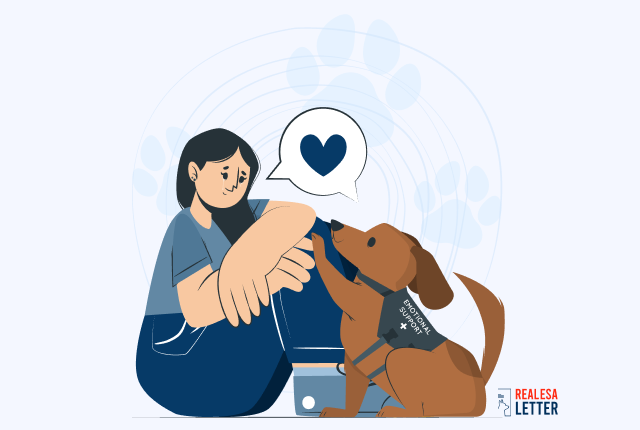
This guide covers public access and housing. It also covers flights and psychiatric service dogs. By the end you will know which animal fits your needs.
RealESALetter.com issues ESA letters for emotional support animals and PSD letters for trained psychiatric service dogs.
Key Takeaways
Task Training Is the Key Difference: A service dog performs trained tasks for a disability. An ESA gives comfort through its presence alone.
Only Service Dogs Have Public Access: The ADA lets service dogs enter stores and restaurants. Businesses can refuse an ESA.
HUD Changed Housing Rules in May 2026: HUD no longer pursues complaints about untrained ESAs. Service dog requests stay presumptively reasonable.
Airlines Treat ESAs as Pets: DOT rules since January 2021 let airlines charge pet fees for ESAs. Service dogs fly in the cabin at no charge.
No Official Registry Exists: No federal registry covers service dogs or ESAs. An ESA is documented only by a letter from a licensed mental health professional.
How Do ESAs and Service Animals Compare Side by Side?
Task training is the difference that drives every other legal right. The table compares a service animal vs emotional support animal. Therapy animals are added for contrast.
Service dog vs ESA vs therapy dog at a glance
Feature | Service Animal | Emotional Support Animal | Therapy Animal |
Role | Performs tasks for one person's disability | Comforts its owner | Comforts many people in hospitals and schools |
Training | Individually trained for specific tasks | None required | Trained for calm behavior only |
Species | Dogs (miniature horses in some cases) | Most common domestic animals | Usually dogs |
Public access | Yes under ADA Title II and Title III | No | Only where invited |
Housing before May 2026 | Allowed in no-pet housing without pet fees | Allowed in no-pet housing with an ESA letter | No protection |
Housing after May 2026 | Requests presumptively reasonable | No HUD enforcement for untrained ESAs | No protection |
Air travel | Flies in the cabin at no charge | Treated as a pet | Treated as a pet |
Workplace | Reviewed case by case under ADA Title I | Reviewed case by case under ADA Title I | No special right |
What staff can ask | Two questions only | Pet rules apply | Pet rules apply |
Registry | None exists | None exists | Private groups may certify |
An ESA letter is the only paperwork tied to an ESA. It helps to know what an ESA letter looks like so you can spot a fake one.
Is an Emotional Support Animal a Service Animal?
No. An emotional support animal is not a service animal under the ADA.
The Americans with Disabilities Act defines a service animal as a dog individually trained to do work or perform tasks for a person with a disability. A guide dog for a blind person is one example. A dog that alerts its handler before a seizure is another. The ADA also allows trained miniature horses in some places.
An emotional support animal (ESA) helps through its presence alone. It needs no task training. Most ESAs are dogs or cats. An ESA is backed by a legitimate ESA letter from a licensed mental health professional. That letter matters in housing. It does not turn the animal into a service animal.
Some people use the term "emotional service animal." No such legal category exists. An animal is either task trained under the ADA or it is not.
Where Can a Service Dog Go That an ESA Cannot?
A service dog can go almost anywhere the public is allowed. An ESA has no public access right under the ADA.
The ADA covers service dogs in two settings. Title II covers state and local government places. Title III covers businesses open to the public. An ESA gets no access under either one. This is the core of the service dog vs emotional support dog divide. The guide to ESAs under the ADA explains why a store or restaurant can say no.
Place | Service Dog | ESA |
Stores and restaurants | Allowed under ADA Title III | Can be refused |
Hotels | Allowed with no pet fee | Hotel pet rules apply |
Government buildings | Allowed under ADA Title II | Can be refused |
Hospitals | Allowed except sterile areas | Can be refused |
Workplace | Reviewed case by case under ADA Title I | Reviewed case by case under ADA Title I |
What Can Staff Ask About a Service Dog?
Staff can ask only two questions:
- Is the dog a service animal required because of a disability?
- What work or task has the dog been trained to perform?
Staff Can | Staff Cannot |
Ask the two questions above | Ask about your disability |
Remove a dog that is out of control | Ask for papers or an ID |
Remove a dog that is not housebroken | Require a vest or harness label |
Charge for damage the dog causes | Ask the dog to show its task |
The Department of Justice service animal FAQ lists these rules in full. It also confirms that ESAs and therapy animals do not qualify.
What Did HUD Change for ESAs and Service Dogs in 2026?
HUD rescinded the two guidance notices that covered ESAs and service dogs in housing in May 2026.
Before 2026 HUD treated both animals as assistance animals under the Fair Housing Act. On May 22, 2026 HUD rescinded FHEO Notice 2013-01 and FHEO Notice 2020-01. HUD now finds a violation only for animals individually trained to perform disability-related tasks. This matches the ADA standard.
HUD Rule | Before May 2026 | After May 2026 |
Guidance in force | FHEO Notices 2013-01 and 2020-01 | Both notices rescinded |
Animals HUD protects | Trained and untrained assistance animals | Individually trained animals only |
Service dogs | Allowed in no-pet housing | Requests presumptively reasonable |
ESAs | Allowed in no-pet housing with an ESA letter | HUD no longer pursues complaints |
Pet fees | Waived for both | No longer expected for ESAs |
Next step | None | HUD plans formal rulemaking |
The HUD ESA enforcement guide breaks down what the new memo says.
What Does This Mean for ESA Owners?
ESA owners lost HUD enforcement but kept the Fair Housing Act.
- HUD will not pursue complaints about untrained ESAs.
- The Fair Housing Act itself did not change.
- Tenants can still file private lawsuits.
- Some state fair housing laws may still protect ESAs.
Every RealESALetter.com ESA letter lists the clinician's state license number and contact details so housing providers can verify an ESA request under the Fair Housing Act.
What Does This Mean for Service Dog Owners?
Service dog owners keep strong housing protection. HUD treats requests for trained assistance animals as presumptively reasonable. A task-trained dog stands on firmer ground than an ESA in housing today.
Can ESAs and Service Dogs Fly in the Cabin?
Only service dogs have a legal right to fly in the cabin. Since January 11, 2021 DOT rules let airlines treat emotional support animals as pets.
The Air Carrier Access Act rule defines a service animal as a dog individually trained for a person with a disability. Psychiatric service dogs count. ESAs and comfort animals do not.
Air Travel Rule | Service Dog | ESA |
Legal status | Service animal under the ACAA | Pet |
Cabin access | Guaranteed | Only if the airline allows pets in the cabin |
Fees | None | Airline pet fee |
Paperwork | DOT Service Animal Air Transportation Form | Airline pet policy forms |
Species | Dogs only | Set by each airline |
Can the airline refuse it? | Only for safety or behavior reasons | Yes |
Airlines can ask for the DOT form before the flight. The form covers the dog's training and health and behavior. The Department of Transportation service animal page explains what airlines can and cannot require.
Do State Laws Treat ESAs and Service Animals Differently?
Yes. More than 30 states penalize people who pass off a pet as a service animal.
These laws target false claims in public places. Penalties are usually misdemeanors or civil fines. Some states add community service. About 16 states also have laws against fraudulent assistance animal claims in housing.
A vest or an online "registration" does not make a pet a service animal. The fake service dog guide explains the penalties state by state.
Which One Fits Your Situation?
The right choice depends on where you need your animal with you.
- You need comfort at home. An ESA may fit. A letter from a licensed mental health professional supports your housing request.
- You need help in public for a mental health condition. A psychiatric service dog may fit. The dog must be trained to perform specific tasks. It is a service animal trained for tasks such as deep pressure therapy. The psychiatric service dog vs ESA guide explains this path.
- You need help with a physical disability. A service dog trained for that disability fits.
- You have no qualifying condition. Your animal is a pet. No letter or vest changes that.
Not sure your condition qualifies? The guide on how to qualify for an emotional support animal lists the conditions clinicians usually review.
Summing Up!
Training is what separates a service animal from an ESA. Service dogs keep broad rights in public places and on flights and in housing. ESAs now depend more on state law and a verifiable letter. Find out if an ESA letter fits your needs through a short evaluation with a licensed clinician.
Frequently Asked Questions
Can one dog be both an ESA and a service dog?

No. The law treats a dog as one or the other based on its training. A task-trained dog is a service animal even if it also gives comfort. A dog without trained tasks is an ESA even if it is calm and well behaved.
Can I have an ESA and a service dog at the same time?
Yes. Each animal must meet its own standard. The service dog must be trained to perform tasks for a disability. The ESA needs a letter from a licensed mental health professional.
Is an ESA or a service dog easier to get?
An ESA is usually faster to get. It needs an evaluation and a letter from a licensed mental health professional. A service dog needs individual task training. That training often takes months.
Does a service dog in training have the same rights as a service dog?
No. The ADA covers only dogs that are already trained. Some state and local laws give public access to dogs still in training.
Do service dogs and ESAs follow the same leash rules?
No. The ADA requires a service dog to be harnessed or leashed or tethered. The exception is when that gear interferes with the dog's task or the handler's disability. An ESA follows local leash laws and the pet rules of each property.
Harper Jefcoat is a content writer with 10+ years of experience covering ESA laws, mental wellness, and emotional support animal benefits. As a blog author for RealESALetter, he educates readers on ESA regulations and promotes ethical documentation practices.

Tina Logan is a Licensed Marriage and Family Therapist with 20+ years of clinical experience and an active California Board of Behavioral Sciences license. She conducts ESA and psychiatric service dog evaluations for RealESALetter assessing whether an ESA or task-trained PSD is clinically appropriate.

Don't worry. Your pet stays with you.
Housing law is on your side
- 1A few questions. That's your paperwork
- 2A licensed therapist reviews your case
- 3Official ESA letter, ready to send
Not accepted? Full refund, guaranteed